MeshEMS board
NESL · OpenAMI-aligned · multi-tenant edge metering · workshops & field deployments
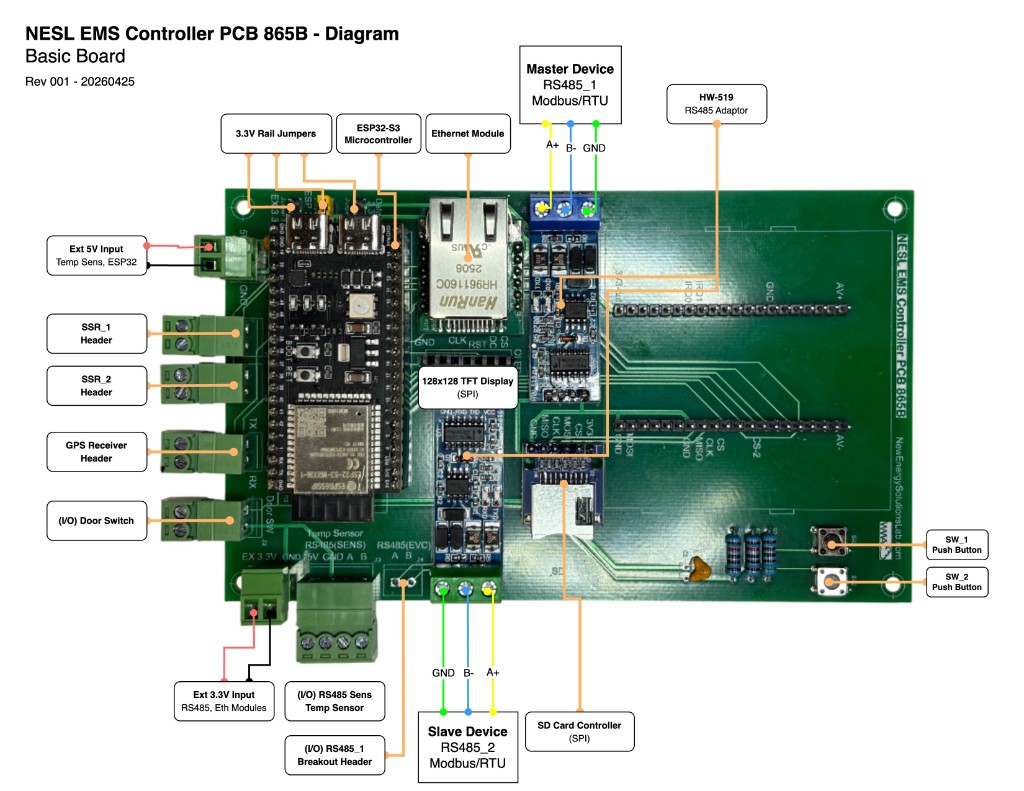
Board diagram
Bill of materials (BOM)
Living parts list for MeshEMS / Street-EMS dev kits — components, sources, and workshop kit quantities. Maintained in Google Sheets (view access; request edit from NESL / Energy IoT Open Source if you are building kits).
MeshEMS board BOM (Google Sheets) ↗
The MeshEMS board is an ESP32-based EMS PCB designed by NESL in alignment with OpenAMI — mesh-capable neighborhood-area networking for DCU backhaul when pole-to-pole RF redundancy is needed. OpenAMI metering firmware targets the NESL 865B: meshems-openami-metering.
Modbus RTU meters (DDS238, CHD130, DDSU666) or CircuitSetup ATM90E32 6-channel SPI; MQTT northbound; SSR load control. Schematic: meshems · BOM.
Why this board exists
A multi-tenant edge metering system — one pole gateway for several customer circuits (~6 homes or loads) with clear separation of what belongs upstream vs downstream of the revenue meter. Used in workshops, hackathons, and field deployments; documented in the open so communities can reuse the lessons and develop technological autonomy early during rapid load growth.
Upstream · meter · downstream
A practical first step is to clarify and isolate knowledge on each side of the revenue meter. MeshEMS sits at that boundary and makes interoperability visible — what the DCU must speak upstream versus what each customer circuit needs downstream.
Upstream of the meter
- DCUs and pole gateways
- Utility / feeder systems
- Head-end, vending, operator backends
- Northbound MQTT · geo asset model
Downstream of the meter
- Multiple homes and customer circuits (~6 per board)
- Per-tenant reads, credit, disconnect
- Branch loads, anchor tenants, theft visibility
- Off-the-shelf meters and SSR control
← revenue meter / gateway normalization →
OpenAMI · OBIS · building in the open
OpenAMI — actionable telemetry and leakage visibility (feeder → branch → customer). OBIS · VMRS — shared register semantics northbound. ISV curates workshop notes, gap matrices, and distribution lists in alignment with EnAccess Foundation, Energy IoT Open Source, NESL, and field operators.
Role in the stack
| Layer | MeshEMS |
|---|---|
| Southbound | DLMS / OEM meter interfaces via gateway firmware; pairs with CircuitSetup and other bench/field meter boards. |
| Edge | ESP32 EMS — mesh NAN between DCUs; optional when a single Street Pole gateway is not enough for feeder coverage. |
| Northbound | MQTT / JSON registers aligned to OBIS · VMRS — same OpenAMI contract as EnAccess Foundation MPM and operator backends. |
| Firmware | meshems-openami-metering (865B · OpenAMI) · meshEMS (Street Pole EMS) |
Events & deployments
MeshEMS is a shared platform — not built for a single conference. Scheduled and in-flight uses include:
- Power Africa Conference 2026 · OpenAMI EMS Workshop · OSEAS 2026 · Open Energy Hackathon 2026 — v2.0 (NESL 865B) kits
- Open Energy Hackathon 2025 · Power Africa OpenAMI 2025 — v1 EMS Dev Kit Rev 001 (board photos on those event pages)
- Board distribution — field partners (Redwan Hussain, Sean White / NABCEP, Energy IoT Open Source early adopter)
- Jude · 10× EMS deployment — REIc / operator pilot track
- meshems-openami-metering — Nearly Free Energy Uganda site-layout lab (dashboard + GeoJSON)
MeshEMS vs Street EMS
MeshEMS — single-pole ESP32 gateway prototyped at the 2025 Open Energy Hackathon; live metering, SunSpec telemetry, MQTT northbound.
Street EMS — NESL PCB variant with mesh backhaul so multiple DCUs can form a neighborhood-area network when line-of-sight or single-hop RF is insufficient. Use when the OpenAMI deployment needs redundant pole-to-pole links, not when a standalone pole gateway is enough.
Power rails (workshop)
Bench and field kits need planned 5 V and 3.3 V rails — see 25 Jun 2026 notes · MeshEMS power architecture.
ISV wiki threads
- OpenAMI hub
- Village Metering · Overview · Problems
- Power Africa OpenAMI deck (Sep 2025)
- Power Africa 2026 workshop planning
- 25 Jun 2026 · power rails · distribution
External links
- MeshEMS board BOM (Google Sheets)
- Energy IoT Open Source · meshems-openami-metering — OpenAMI metering app for NESL 865B
- NESL · PCB865B-NESL-EMS-Controller — schematic
- Energy IoT Open Source· meshEMS — Street Pole EMS dev-kit
- EnAccess Foundation · OpenAMI
- OSEA Discord